Showing posts with label Senegal. Show all posts

South for the Winter


My Senegalese adventure was cut short as I found work in Sierra Leone and the beginning of 2013 saw me head off to pastures new. The first stop was in the opposite direction as I went up to Dakar, firstly playing the tourist guide to my parents for a few days and, having seen them off back to Europe, organising visas for the trip down. The Sierra Leonean embassy was slated in for Friday and, having initially struggled to find the door, I wandered in to find absolutely no one aside from one other guy who seemed to have been waiting for quite a while for something to happen. About an hour later people emerged into the room explaining that they had been in a meeting, seemingly unconcerned by the fact that we could have cleared the office of everything of value including computers, handbags and so on. They then explained to me that they didn’t take care of visas on Fridays and I would have to come back on Monday. So I came back on Monday, handed in all of my papers and was then asked to wait. Four hours of waiting later, I was told that the embassy had run out of visa stickers. Quite why they hadn’t realised this earlier I’m not sure but in any case the result was that for 15€ I got a little letter addressed to the border guards asking that they issue a visa to me there. The Guinean embassy was more forthcoming and the next day I packed up my stuff and heading back down for the long trek south.


Big statue, Dakar.

The men are very impressed

Final family portrait, Gorée Island


Dakar to Ziguinchor went as it usually does – I got shafted for my bags at the taxi station in Dakar, got stuck in the most uncomfortable seat in the bush taxi and rolled into Zig 10 hours later to spend my last night and say goodbyes to the gang. It was sad to leave a town I’d come to call home and people who I’d come to consider good friends but I was sure I’d see them again. The goodbyes went on long into the night and I left Zig with a smile on my face and a pounding headache without much of a plan. I got to Bissau and got into a car headed for Quebo, the Guinea-Bissau border town where I hoped to find transport down to Guinea. This hope was based on the fact that I’d seen a road go over the border on maps but little more than that. As we pulled into a non-descript one street town under cover of darkness, the driver announced that this was the end of the road. I had arrived in Quebo, it would seem. In an awkward mishmash of French, Spanish and Portuguese I asked the driver if he knew where I could spend the night and this seemed to cause more trouble than I thought. A long discussion erupted involving several passers-by, none of whom seemed to think there was anywhere to stay the night until one said he thought I could go to the customs building and find something from there. The driver bundled me back into the car and drove back the way we’d come to the other end of town. Here, more discussions ensued; one of the customs guys disappeared and came back with a kid of about 16 years old who took me into the bushes behind the customs house and to a small house. I had found Quebo’s only hotel, and 5000cfa got me a mattress, a lamp, a bucket of cold water and the company of several cockroaches. These were quickly dispatched with and before I knew it an army of ants were charging across the room, dissecting the corpses and lugging them back towards the corridor. The final aim of the night was the find food and water and the kid in charge took me down the road to another guy who sold me a lump of goat in a plastic bag and I settled in to sleep.

The tools at my disposal...

Next morning my new friend the hotel manager, unfazed by the fact that my Portuguese language skills didn’t amount to much, patiently explained my transport options to get to Guinea over and over and hence I ended up sat in the back of an old French military truck and was informed that we would leave in the morning and arrive at 4pm. It was only at the end of the day that I realised that this meant 4pm the next day and so began my 33 hours on top of a peanut truck.
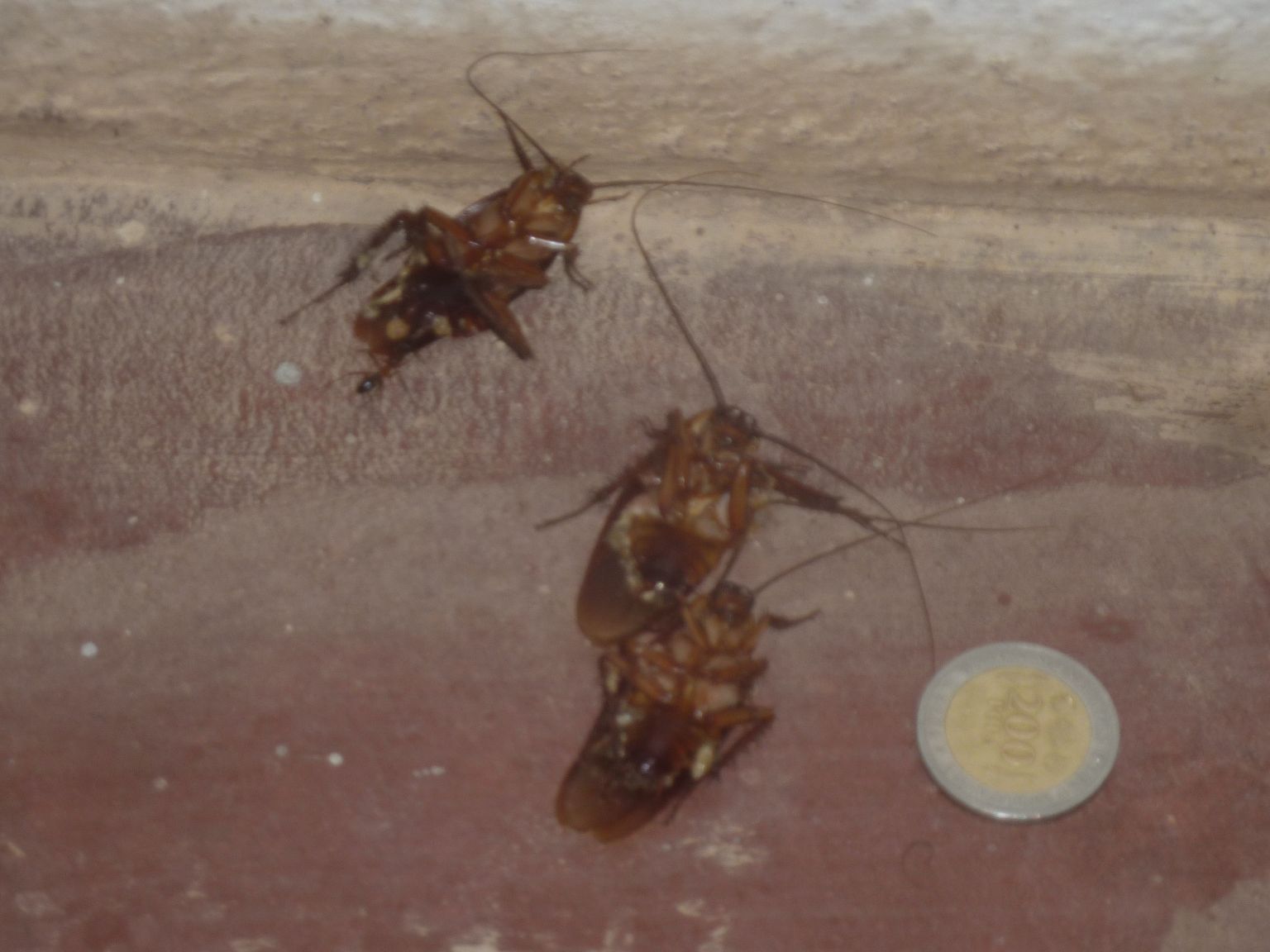
Roommates, Quebo

The first stop after leaving was Quebo market, around 1km from where we started. I’m not completely sure of the point of this stop and no one seemed to do much and nothing was loaded onto the truck but, believing that I would arrive in my destination of Boké that afternoon I bought a couple of bottles of water and waited. After a couple of hours we eventually pulled out and stopped at the next village where sacks of peanuts were loaded onto the truck. This pattern was repeated until we got to the border post where another inexplicable 3 hour wait took place. I was stamped out of Guinea-Bissau, we pulled off the main road and rattled our way down an increasingly unlikely looking road. This road occasionally disappeared and we drove along rivers, stopped off at more villages, loaded up with more peanuts and eventually the assembled passengers were teetering on top, holding on for dear life on the spectacularly uneven track and ducking to avoid overhanging branches. I’m quite proud that for the entire ride I was only hit in the face once by these branches even after, eventually, one of the passengers started feeling sorry for the truck’s only tourist and invited me forward to sit on top of the cab. Up until this point I had been making contingency plans for where to jump in case the truck toppled over, which seemed very likely on quite a few occasions, and I decided that being on top of the cab would mean a decreased chance of my life coming to an abrupt end underneath several tons of peanuts. We eventually got to the Guinean entry post where two rather bored looking policemen decided to have some fun with us and with me in particular, I presume in an attempt to extract as much cash as they could from this rare vehicle passing through their post.


"THE TRUCK", pre-peanuts

Their first attempt was to persuade me that I didn’t have a visa, an accusation which I easily disproved by showing them said visa. After staring at it for a strangely long time, they asked for my yellow fever vaccination certificate, which I told them was in my bag on the truck, and was sent to fetch it. Having scrutinised this, they then asked for my declaration de mission, effectively a letter from the person who sent me to Guinea with an explanation of what I was doing there. The fact that I was on a tourist visa and had told them I was in transit to Sierra Leone didn’t cut the mustard and flickers of a smile appeared on their faces as they realised they may have caught me out. “I have a letter from the embassy…” I ventured, and was instructed to get that. Back onto the truck and into my bag, back down to the guards. The letter which I’d got from the Sierra Leonean embassy in Dakar absolutely did not explain why I was in Guinea, nor did it contain any kind of mission statement but it was written in English, which the guys didn’t understand. Instead, they went through my name and passport number letter by letter to check for any discrepancies. Sadly for them, they found none and stamped my passport. Then, naturally, they told me that I had to pay for the stamp.

No ambiguity there - what else can we sting him for...?

“I’ve already paid for the visa ! I don’t pay for the stamp !” I told them.

“Ah, and where does it say that you have paid for the visa ?”

I’m honestly not sure if these guys were stupid, playing stupid or a combination of the two but I didn’t know how to explain to them that visas cost money without being patronising. Fortunately, I didn’t need to do this as, for some reason, Guinean visas have the price written on them. I showed them the visa again.

“OK… and have you paid for this stamp ?”

This stamp was my Guinea-Bissau exit stamp. I told them it wasn’t from their country and asked them why they would care if I’d paid or not. This argument got nowhere so I showed them my Guinea-Bissau visa. They stared at it for a while and then announced sadly that it appears I had paid for everything. I got back on the truck and after a bit more waiting around we trundled off.

By 6pm we hadn’t covered many of the 160km between Quebo and Boké although we had picked up quite a lot of peanuts. We pulled over in a village where everyone hopped off and one of the passengers told me that we were near a military camp and would have to wait until morning before leaving again. Another passenger bought me a couple of bottles of water as I’d run out a long time ago and had no Guinean francs, and one of the driver’s assistants made me a makeshift bed from the peanut sacks. I chatted with some of the others for a while before everyone turned in to sleep, the peanut sacks transformed into a crowded dormitory, and a tarpaulin was hauled over the top of us. At 2am I woke up with an unfamiliar feeling – I was cold ! Condensation had formed on the inside of the tarpaulin and was dripping off it and onto the people huddled underneath. For some reason no one else seemed to be bothered by this and so I clambered over a row of bodies to my bag to get some extra clothes and my sleeping bag. One of the guys woke up and when news got around that the toubab was cold, laughter erupted.

We were up and off again at 5.30am and managed about a kilometre before we got to a big river. The way across was on a diesel powered floating platform and a few of us went across on a very sorry looking canoe which took water by the bucket load, leaving us to frantically bail it out with our flipflops. We got the the other side where an old military guy was waiting and he regaled me with tales of working for French and German companies in the 1960s and 1970s and was the first Guinean in uniform I’d met who didn’t seem interested in extracting any money from me. He would have had ample opportunity as we waited for 4 hours in this village, firstly for the river level to rise and then as the diesel engine on the floating platform broke down, but instead shook my hand and wished me a pleasant trip, instructing me to come and say hello if I ever come through the village again. We then stopped in the next village and picked up more peanuts.
The promised moment eventually came and after 33 bone-rattling hours we hit tarmac and rolled into Boké where I picked up my bags and headed off to the market to pick up a car to Conakry. 

Nearly there !

Fellow passengers

In sharp contrast to the peanut truck, the white knuckle ride on a flawless road took me twice the distance in just 3 hours. Here, my world changed as I stayed with Mark, a friend of Ross’s who lived in a sumptuous house with a swimming pool, wifi, air conditioning, a pool table and various other things that I could have easily forgotten existed over the last few days. His hospitality was second to none and I left Conakry refreshed despite the fact that the town itself was a dump. I generally like big African cities but Conakry did very little to endear itself to me save one of the best chawarmas I’ve had in a long time.

The trip down to Makeni, my new home, was smooth and before I knew it I was settling in and ready to start a new chapter of life and discover a new country, a new way of life… 

Crime and Punishment (part 2)


Our knowledge of the centre of Ziguinchor, its bars and restaurants were second to none. However, our usual football-watching bar was slightly unreliable and we had heard persistent rumours of a place called le Makari out in the distant district of Nema (a district which gained worldwide notoriety for my house of incarceration a few weeks previously) which had a large TV and showed football. It was a beautiful sunny Saturday afternoon and Ross, Louise and I walked off in the direction of the airport, armed only with a small piece paper with “Makari, Nema-HLM” written on it in order to ask for directions if, by any chance, we got lost on the way. Surprisingly, we managed to find it with only a few detours and tentatively opened the door. Le Makari is located in a small street where paving slabs are strewn over the road and is unprepossessing from the outside. A small sign on a small metal door is all that hints to anything being inside. However, the courtyard was shiny, the tables were covered with tablecloths, the bar was amply stocked and it had quite probably the largest TV in Ziguinchor ! It was a gem – the cold beer washed the football down very well and we left happy with our new discovery.
 
It was decided that we’d do a little bar hopping in the way back rather than taking a taxi home and we wandered a little further to a place called Bar Nema, another unprepossessing looking place. The room was standard for a cheap Ziguinchor bar – rickety wooden tables, plastic chairs (some still with 4 legs) and a general dearth of light. However, out the back was a courtyard showing that Africa always has the capacity to surprise, for the courtyard was home to the largest speakers I’ve seen outside of a festival and they were being used with much vigour, to the point where we concluded that conversation was pointless and so started playing cards. People started piling in and were merry and one of the more spectacularly drunk patrons attempted to play cards with us but unfortunately his alcoholic haze prevented him from getting a real grasp on the game and he would just put cards down at random, regardless of whether it was a suitable card to put down or whether it was his turn. A few other drinkers gathered around to table to watch. There are not many places in the world where a game of cards becomes a spectator sport but Bar Nema was definitely one of them !

"Hurrah ! Nothing has been stolen yet !"
 
The time came to move on to somewhere slightly calmer and hunt for some food and Chez Euge, just down the road fit the bill. The wine was cheap, the volume of the music permitted talking, some kids enjoyed got a dance with the toubabs and the ladies in the kitchen served up a huge bowl of grilled warthog to us for a pittance. As usual, our afternoon trip to see the football led to us returning home at 2am.

Senegalese wrestling (thanks Louise and Ross for the pics !!)
 
As I got up around 5am to rush to the toilet, Marta came out of her room to inform me that we’d been burgled. My laptop was gone, as was the projector we’d borrowed from work. A trip to the police station to report the theft was met with a delicate touch of disinterest from the local coppers who had just sit down to lunch and so weren’t really in a hurry. Eventually, I was invited to give details of the incident and I’d be given a letter, although I didn’t detect any hint of willingness to actually do anything about the problem. Come back tomorrow, I was told.
 
As I came back the next day I was told that the guy who does the letters hadn’t had time to do it so I should come back tomorrow. As I came back the next day I was told that the guy who does the letters wasn’t around at the moment so I should come back tomorrow. Ad infinitum.
 
Conclusion : If you’re going to commit a crime in Senegal, make sure it’s burglary. It’s a less serious crime than not carrying ID.

Crime and Punishment (part 1)


It is a well-known fact that the traveller must be aware of the laws of his or her host country and, failing to observe said rules, must be prepared to incur the wrath of the local authorities. As such, I have refrained from drinking on the street, streaking through town, beating up members of the police force and various other things which can land one in hot water in Senegal. Sometimes, however, the smaller details of the law can escape you.

Having finished a project at work which had taken a long time and then been delayed several days by poorly-timed and incessant power cuts, we celebrated in style by buying a couple of cheap bottles of wine (which incidentally, considering they say “bottled in Dakar” on the labels and bear no indication of their origin, hence probably somewhere like Belarus or Tajikistan, are very good) and having them with cake.

Living it up, Ziguinchor style

Two of the more uncontrolled of us (namely Louise and myself) decided that this was not sufficient and wandered off to the local shop to pick up more. Unfortunately, it was half past midnight by this point and the shop was rather predictably closed but a helpful bystander pointed us up the road to a bar where we could purchase takeaway bottles. I asked for a couple of bottles, Louise sat down and ordered a beer, and so I got a beer as well. All went well for about 10 minutes, chatting with some guys at the bar on topics which I no longer remember but were surely very interesting, when a group of rather heavily armed men in uniform burst in. Quite why they needed portable rocket launchers or some such just to go around bars checking peoples’ IDs is beyond me, but the upshot of the story is that I had left my ID at home and was unceremoniously marched off to a pick-up waiting outside and was driven off to jail. Louise is always a willing soldier to help out those in trouble and took a taxi home to pick my passport up before chasing our truck to the jail. She arrived before me as we had stopped to raid every other bar in town and, by the time 17 of us lawbreakers came through the gates of Nema police station, Louise had already been carted off into a room and chatted up by friendly Gendarmes. I saw the bright lights of freedom before me as Louise gave my passport to the guy in the office but, rather than shaking my hand and sending me on my way with a smile as I had hoped, he sat down and started watching football on TV. Louise’s desperate pleas of “I’m tired, please let him out” fell on deaf ears and at 3am she was persuaded to leave the premises.

What came next was probably not the most luxurious night I’ve ever spent – 17 guys stuffed into a room about 7m² with a concrete floor and one of the world’s smelliest toilets poking its stinking tentacles into our accommodation for the night. Putting myself into an improbable foetus-like position and using my flipflops as a pillow I somehow managed to get half an hour’s sleep before a fellow jailbird accidentally sat on my head in the dark, and that was all the sleep I managed to get that night. We eventually got to morning where I had high hopes. Louise had been promised that I would be out by 8am. The Senegalese police run on African time though and the officers responsible for our cases didn’t even arrive until 9am and then began a painstaking operation to take down our details. The first guilty man went out, answered various questions about his name, address and so on and was then required to give fingerprints from all ten fingers, for a reason I didn’t manage to work out. The interviewing officer would then watch some TV, disappear for a while and then come back, watch some more TV and call someone else over. A process that should have taken 20 minutes took 4 hours and we were then all instructed to come out and sit on the floor. The officers then had a chat with each other and watched more TV, leaving us prisoners wondering if we would ever see our homes again, but then finally gave us all a lecture about carrying ID. One of the officers then sat at the desk, having a chat with people one at a time and ushering them outside. My interview consisted of a request for money and a denial that I had any on my side, a doubtful look before he impatiently waved me out. I was finally free !

A P.S. on the importance of learning your lesson. The next day, we went on a weekend trip to Bissau and were stopped at the first roadblock out of Ziguinchor. Surprise of surprises, it was manned by none other than officer Diallo, the bribe requester from the previous day. I decided to wave at him out of the window at which point he ordered everyone off the minibus.

“So !” he said. “You recognised me !”

“Yes I did sir”, I replied

He asked me where I was going and for my ID, which I proudly presented to him. He then shook my hand and assured me that if I was caught without ID again he would ensure that I don’t spend the night locked up again. In exchange for the appropriate service fee, I presume…

Return


Geneva to Ziguinchor, Senegal - October 3rd-5th 2012 

I was not fortunate enough to get offered a salary for it but I was fortunate enough nonetheless to be offered a 6 month internship in the southern Senegalese city of Ziguinchor. It was a place I’d visited once before in 2006 and had fond memories of so it was a great opportunity to a) work for nothing as opposed to sitting around at home for nothing, b) get away from the European winter and finally get revenge on all of those who called me from warmer climes on those cold April mornings when I was living in Helsinki and c) get within view of the first rung on the job ladder which was seeming ever more elusive.

The cheapest way there was with Turkish Airlines, the company which very kindly left my mother and I in the crap for 2 days in Abidjan a couple of months ago. I had a 22 hour layover in Istanbul which I figured was probably enough to account for Turkish Airlines scheduling, booked myself a dorm bed in a hostel downtown and hit the airport for the uneventful flight to Turkey.  I had a vague knowledge of how to get into the centre of town and after a metro and tram ride to the stop by Hagia Sophia, I realised that I had no idea where this hostel was aside from that it was roughly in this area. I had a street name which no one (including the taxi drivers I asked while wandering around) seemed to have heard of and the name of the hostel which, obviously, no one seemed to have heard of. Having walked around old Istanbul for well over an hour during which I accosted various people in the street, restaurant owners and tourists armed with guide books all to no avail, I finally found another hostel where I got directions to the one I was looking for. It was approaching 1am so I did the sensible thing and walked off to get an Efes beer, had a chat with a couple of Italians on the next table and hit the sack quite a bit later than I probably should have. Two hours later, I was woken up by someone in the dorm heading to the toilet and then kept awake by someone else who was snoring with great vigour and after several more hours of sleeplessness I decided to get up. My flight wasn’t until late in the evening and I’d planned to have a day walking around Istanbul. I’d had this same plan on the way back from Abidjan but had been foiled by the flight delay, and this plan was now foiled by a quick inspection of my bag which revealed that I had forgotten to pack swimming shorts and the cables for both my shaver and my laptop.

Having quickly considered growing a large beard, being unable to work and being reduced to skinny dipping, I headed off to a part of town I’d seen on the way in which seemed loaded with electronics shops. The street on the way there was full of clothing shops and housed probably enough bikinis for every woman in Turkey yet male customers were, as in many places, slightly less enthusiastically catered for. I finally found a shop where I was directed to the basement but decided to pass on the small selection of garish Speedos, gave up on this quest and went on a hunt for the laptop cable. An hour later I found a shop with a decent selection, found the cable and whipped out the 17 lira indicated on the front of the box and was promptly informed that the price wasn’t in lira but in US dollars. After a bit of discussion I managed to pay in Euros and emerged into the bright Istanbul sunshine intent on doing at least a bit of tourism. Having seen a few of the mosques and landmarks in town and went for the totally pointless yet satisfying quest of walking from one continent to another, spotted the closest bridge from Europe to Asia and set off on what turned out to be a 2 hour trek to where I discovered the bridge was for vehicles only. A slight letdown, and it was time to head back to the airport for my flight to Dakar.

Despite my experiences coming back from Côte D’Ivoire, I had to say that Turkish Airlines’ inflight entertainment system is second to none and I spent the 10 hour flight watching films, various series and playing Sudoku on my little screen in the seat in front of me and enjoying the food which is, by airline standards, pretty good. Washed down with a little Turkish red wine of course...

Dakar airport can be a slightly bewildering experience. I’d only been here once before and it was to fly out and so the arrival was a new experience. The baggage hall was packed with guys who were trying to help me with my bags and enquire as to whether I’d been to Senegal or not and by the time I’d shaken them off and got to a little hostel by the airport it was 1am. Displaying much sense just like when I arrived in Istanbul, I took a Gazelle beer and enjoyed the heat, still close to suffocating at this time of night, sent a few emails back home and got to sleep at 3am. 6am came, my alarm clock went off and I dragged myself out of bed again to Dakar’s central station, a vast wasteland filled with the saloon cars that make up the majority of Senegal’s public transport system. Waiting time can be anything from minutes to hours as you wait for the car to fill up, being offered everything to buy while you wait – sunglasses, phone chargers, food and drink, mobile phone holders and what can only be described as some sort of assault flick-knife which I assumed would be far more useful to the vendor as a tool for mugging passengers rather than something to sell.

Comfort-wise, the trip depends very much on when you arrive at the station. The first passenger gets the front seat and travels in luxury, the next 3 get the middle row which is fine, and the last 3 are squashed into the back row like sardines. I arrived 5th and so had a place in the back row but still had to wait for another 2 passengers to arrive which they eventually did in the form of 2 large rastamen, meaning that we spent the majority of the 10 hour trip awkwardly squirming, each trying to get a few drops of blood flowing into our feet. The rainy season was just coming to an end and so the country was plastered in a beautiful array of shades of green, dotted with enormous baobab trees, getting greener as we crossed over the Gambia River courtesy of an improbable looking ferry where workers had to build a ramp out of earth every time it docked to allow the trucks and cars off at each end.

Arrival in Ziguinchor 57 hours after leaving Geneva was as good as I could have hoped – met by new flatmates who were all very nice and went straight for beer and chicken with them.

I’m back……